
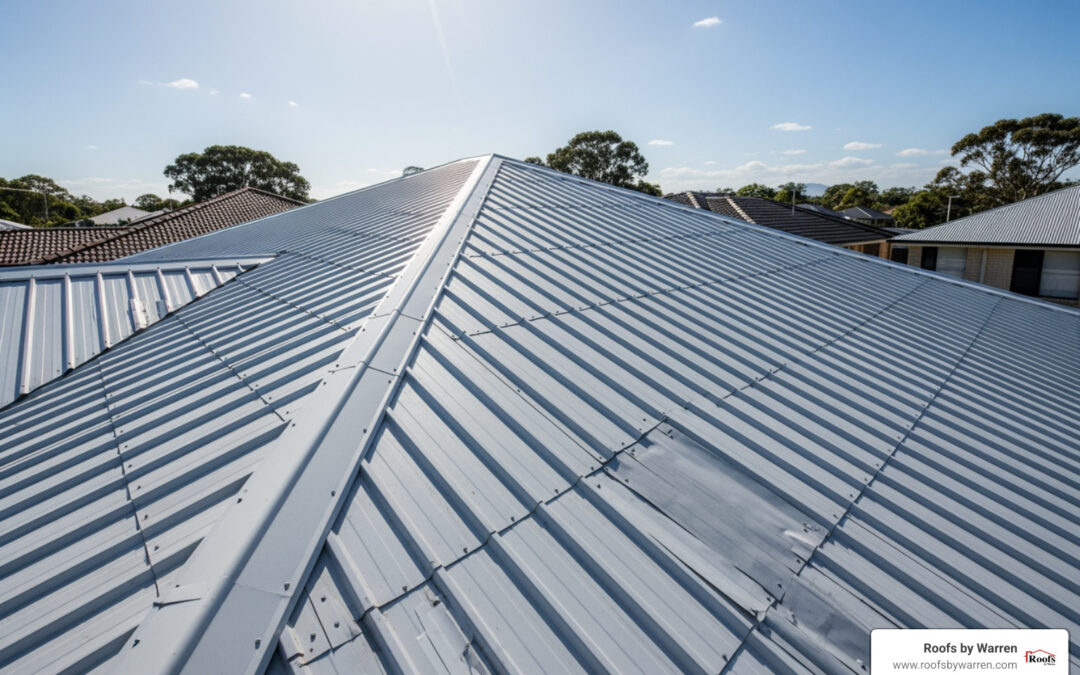
Why Your Roof is Secretly Driving Up Your Energy Bills
Energy efficient roofing is a roofing system designed to reflect more sunlight, emit absorbed heat, and minimize heat transfer into your building through strategic material choices, proper insulation, and effective ventilation. It reduces cooling demand, lowers indoor temperatures, and decreases the strain on your HVAC system.
Key Components of Energy Efficient Roofing:
- Cool roof materials – Reflective surfaces that bounce sunlight away (metal, light-colored tiles, specially coated asphalt shingles)
- Solar reflectance – The ability to reflect more sunlight instead of absorbing it as heat
- Thermal emittance – How efficiently a roof releases absorbed heat back into the atmosphere
- Proper insulation – Acts as a barrier to prevent heat transfer between your attic and living spaces
- Strategic ventilation – Allows hot air to escape from the attic, preventing heat buildup
A comfortable home without excessive energy waste is the goal. The problem? A significant portion of unwanted heat enters through your roof, as traditional dark materials absorb immense solar energy on hot summer days.
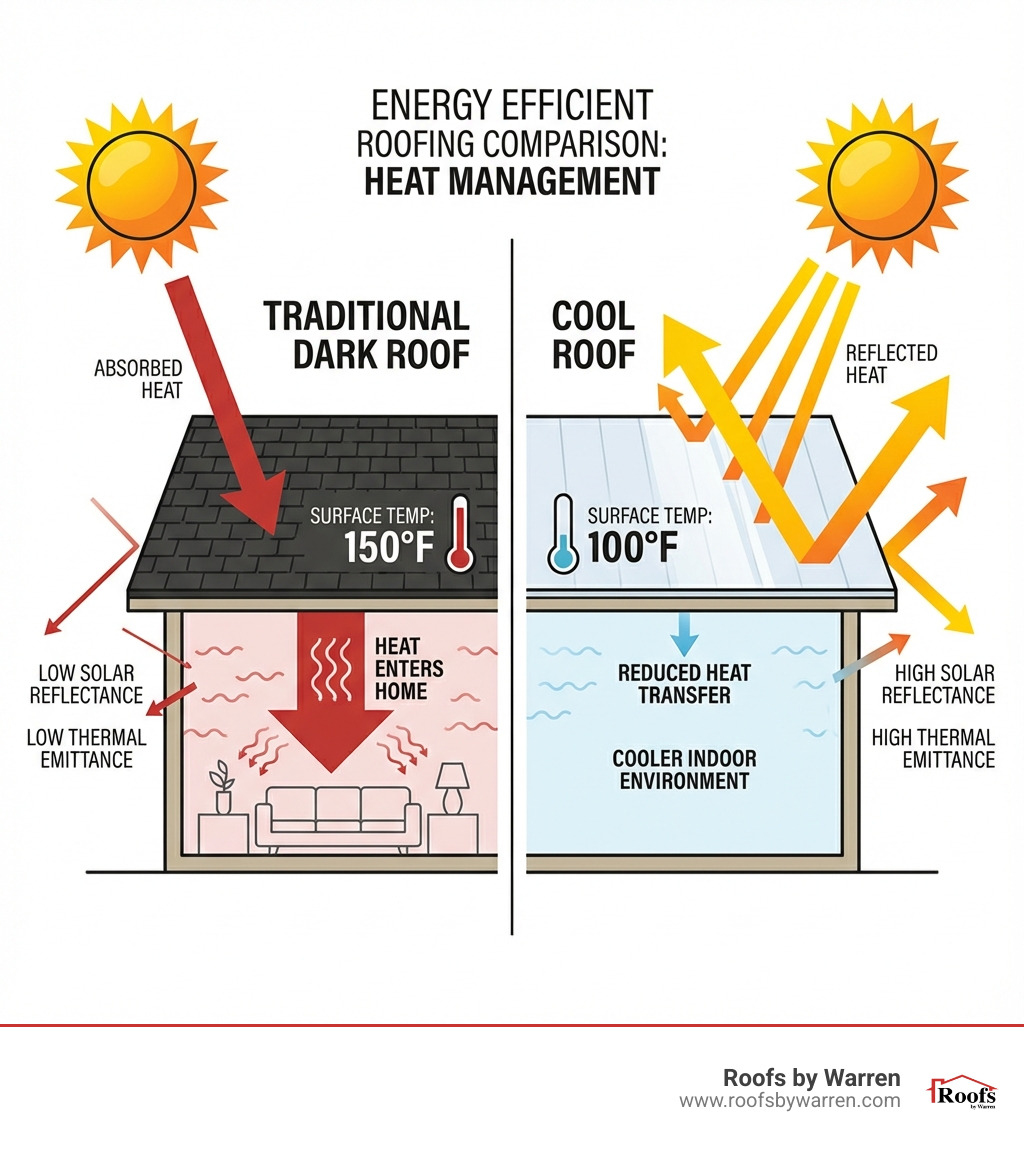
Your roof either works for you by reflecting heat or against you by turning your attic into an oven. On a summer afternoon, a standard gray roof can be dramatically hotter than a reflective white one, which directly affects your air conditioning needs and indoor comfort.
Modern roofing technology offers multiple paths to efficiency without sacrificing aesthetics. Research shows that energy-efficient roofing can lower peak cooling demand and reduce overall energy use.
The Science of a ‘Cool Roof’
One of the most exciting advancements in energy efficient roofing is the “cool roof.” But what makes a roof “cool,” and how does it keep your home comfortable under the intense Ohio sun?
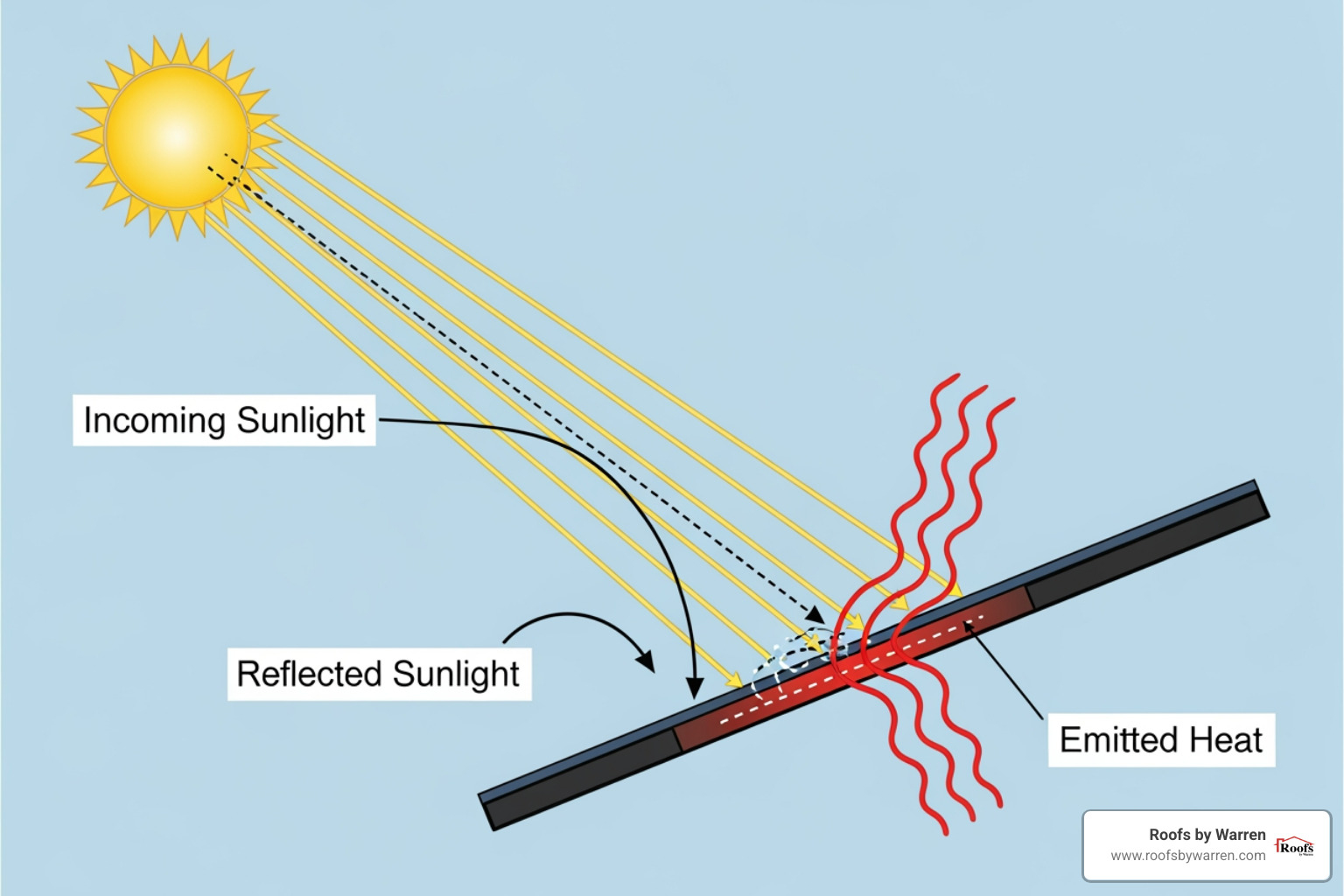
A cool roof absorbs and transfers less solar heat than a conventional one. While traditional dark roofs turn attics into ovens that radiate heat into your living spaces, a cool roof works smarter. It leverages two key scientific principles: solar reflectance and thermal emittance.
Solar reflectance, often referred to as albedo, measures how much sunlight a surface reflects. Imagine a mirror bouncing light away – that’s high solar reflectance. The higher the solar reflectance value (measured on a scale from 0 to 1), the more sunlight the roof reflects, preventing it from being absorbed as heat. You can explore more about this at Solar reflectance.
Thermal emittance refers to how efficiently a surface releases, or “emits,” absorbed heat. Even the most reflective roof will absorb some heat. A high thermal emittance value (also on a scale from 0 to 1) means the roof quickly radiates any absorbed heat back into the atmosphere, rather than holding onto it and transferring it into your home. Learn more about this crucial property at Thermal emittance.
By combining high solar reflectance with high thermal emittance, a cool roof lowers its surface temperature, reducing the heat entering your home. This means less work for your AC system, leading to greater comfort and lower energy bills.
The Role of Color and Reflectivity
We often associate energy efficiency with light-colored roofs, and for good reason. Lighter colors naturally reflect more sunlight. A pristine white roof, for example, can reflect a remarkable 60% to 90% of sunlight, making it the coolest option. This is particularly advantageous in warm climates, helping to keep homes cooler and reduce air conditioning demand.
However, energy efficient roofing isn’t just about light colors. Modern “cool color” pigments allow darker roofs to reflect invisible near-infrared radiation, the main source of solar heat. This means a dark gray or brown roof can still offer significant energy savings.
Research from the Lawrence Berkeley National Lab Heat Island Group highlights the dramatic difference reflectivity makes. They’ve found that on a typical summer afternoon, a clean white roof reflecting 80% of sunlight will stay about 50°F cooler than a gray roof reflecting only 20%. This impressive temperature difference directly translates to a cooler home and reduced reliance on air conditioning. So, while white roofs are champions of heat reflection, you no longer have to compromise on your preferred aesthetic to achieve significant energy efficiency.
Urban Heat Island Effect
Beyond home comfort and savings, energy efficient roofing helps combat the urban heat island effect. This phenomenon, where urban areas are significantly hotter than surrounding rural landscapes, is caused by dark, heat-absorbing surfaces like traditional roofs and pavement that store and re-emit solar energy, raising ambient temperatures.
Cool roofs combat this by reflecting more sunlight and emitting less heat. Lowering roof temperatures across a community helps reduce overall ambient air temperatures. Widespread adoption can decrease the urban heat island effect, reduce city-wide AC needs, and improve air quality by slowing ozone formation.
The Environmental Protection Agency (EPA) provides detailed information on how cool roofs can help communities reduce heat island impacts and risks. You can find more information about this important benefit at the EPA information on heat islands. It’s a powerful example of how choices we make for our homes can have a ripple effect, contributing to healthier, cooler communities throughout Central Ohio.
Key Components of an Energy-Efficient Roofing System
Achieving true energy efficient roofing isn’t just about picking a single material; it’s about a holistic system where all components work together seamlessly. Think of your roof not as an isolated cap on your house, but as an integrated part of your home’s entire thermal envelope. The interplay of materials, design, and underlying structures significantly impacts your home’s ability to maintain a comfortable temperature and minimize energy waste.
A Comparative Look at Energy-Efficient Roofing Materials
The choice of roofing material is a cornerstone of an energy-efficient system. Each material brings unique properties to the table, influencing solar reflectance, thermal emittance, and overall insulation values. Understanding these differences helps us select the best option for your home in Ohio.
| Material Type | Efficiency Level | Typical Lifespan | Key Energy Efficiency Feature(s) |
|---|---|---|---|
| Metal Roofing | High | Long | High solar reflectance, low thermal mass, can be coated with cool colors |
| Tile (Clay/Concrete) | Medium to High | Very Long | Thermal mass, air circulation underneath tiles, reflective properties |
| Asphalt Shingles | Medium | Medium | Available with cool-roof granules for improved solar reflectance |
| Green Roofs | High | Medium to Long | Evapotranspiration cooling, insulation from vegetation and soil, reduces heat flux |
This table provides a snapshot, but let’s dive deeper into what makes each of these materials a contender for energy efficient roofing.
Metal Roofing
Metal roofing stands out as a top performer in the field of energy efficient roofing. Its inherent properties make it an excellent choice for reflecting solar radiation. Many metal roofs boast high solar reflectance, meaning they bounce a significant portion of the sun’s energy away from your home. This is especially true for lighter-colored metal roofs or those treated with specialized reflective coatings.
Beyond reflectivity, metal roofs are also known for their durability and longevity, often lasting for decades with minimal maintenance. They are also highly recyclable, making them an environmentally conscious choice. In Central Ohio, metal roofing proves to be a versatile solution. While it excels at keeping homes cooler in the summer by reflecting heat, its excellent insulation properties, particularly when paired with proper underlayment, can also contribute to retaining warmth during our colder winters. For those interested in learning more about this robust option, we have More info about Metal Roofing. Furthermore, we’ve explored How Metal Roofing Protects London Ohio Homes from Harsh Winter Weather, showcasing its year-round benefits.
Tile, Slate, and Clay
Tile, slate, and clay roofs offer a timeless aesthetic combined with impressive energy-efficient characteristics. These materials possess natural thermal mass, meaning they can absorb and slowly release heat, moderating temperature fluctuations.
One of their unique advantages lies in their installation method. The individual tiles are often installed in a way that creates air channels underneath them. This air circulation acts as a natural ventilation system, preventing excessive heat buildup directly on the roof deck and allowing the roof to “breathe.” This feature is particularly beneficial for temperature moderation, keeping your home cooler in the summer.
Slate, in particular, is renowned for its incredible longevity, often lasting for centuries, making it a sustainable and durable choice. While we’re discussing these beautiful options, you might also be interested in Comparing Asphalt Shingles vs. Metal Roofing for a broader perspective on material choices.
Energy-Efficient Asphalt Shingles
Asphalt shingles are a popular roofing choice across the country, including here in Ohio, due to their versatility and wide range of styles. Traditionally, darker asphalt shingles were known for absorbing a lot of heat. However, modern technology has revolutionized this material, introducing highly effective energy efficient roofing options.
Today, you can find asphalt shingles embedded with special cool-roof granules. These granules contain solar-reflecting technology that allows the shingles to reflect more sunlight and absorb less heat, even in darker colors. This innovation means homeowners in Urbana, London, or Grove City can choose from a broad palette of colors without sacrificing energy performance. These advanced shingles can significantly reduce roof surface temperatures, leading to a cooler attic and less strain on your air conditioning. The best part? Cool asphalt shingles often cost about the same as conventional asphalt shingles, making energy efficiency an accessible upgrade. To dig deeper into this popular material, check out More info about Asphalt Shingles.
Green Roofs

When we talk about energy efficient roofing and sustainability, green roofs are an exciting and increasingly popular option, particularly in urban settings. A green roof, also known as a vegetative roof, involves covering a roof surface with a layer of vegetation planted over a waterproofing membrane.
The primary way green roofs contribute to energy efficiency is through evapotranspiration cooling. As plants release water vapor into the atmosphere, they create a cooling effect, much like how our bodies sweat to cool down. This process significantly reduces the amount of heat absorbed by the roof surface. Additionally, the soil and plant layers provide excellent insulation, reducing heat transfer into the building below during both summer and winter.
Beyond energy savings, green roofs offer a host of other benefits, including improved stormwater management by absorbing rainfall, improved air quality, and the creation of valuable green spaces in urban environments. While more commonly seen on commercial buildings, residential green roofs are gaining traction for their aesthetic appeal and environmental advantages. The EPA provides insights into how Using green roofs to reduce heat islands contributes to broader environmental goals.
Beyond the Shingles: Essential System Components for Energy Efficient Roofing
While the choice of roofing material is critical, it’s crucial to remember that your roof is a system. For optimal energy efficient roofing, we must consider elements beyond just the visible surface.
Proper Attic Insulation
Think of attic insulation as your home’s thermal armor. It forms a critical barrier that minimizes heat transfer between your attic and your living spaces. In the winter, good insulation prevents precious heat from escaping your home through the ceiling, keeping your family warm and cozy. In the summer, it acts as a shield, slowing the downward flow of scorching heat from a hot attic into your cooled rooms.
Adequate insulation helps protect your HVAC system from overworking, extending its lifespan and reducing its energy consumption. We recommend ensuring your attic has sufficient insulation, as it’s one of the most impactful steps you can take for year-round energy savings. For more comprehensive insights into improving your home’s overall energy efficiency, including insulation and air sealing, visit Energy efficiency improvements.
Strategic Roof Ventilation
Ventilation is the unsung hero of an energy efficient roofing system. It’s not enough to just insulate; you need to manage the air within your attic space. Proper roof ventilation, typically achieved through a combination of soffit vents (along the eaves) and ridge vents (along the peak of the roof), creates a continuous airflow.
This airflow is vital for several reasons:
- Heat Management: In the summer, hot air naturally rises and escapes through the ridge vents, drawing in cooler air from the soffit vents. This constant air exchange prevents heat from building up in the attic, which can significantly reduce the load on your air conditioner.
- Moisture Control: In winter, warm, moist air from your home can rise into the attic. Without proper ventilation, this moisture can condense, leading to mold growth, damaged insulation, and compromised structural integrity. Ventilation helps to expel this moisture.
- Preventing Ice Dams: In colder climates like Ohio, good ventilation helps keep the roof deck temperature more consistent with the outside air, reducing the chance of snow melting and refreezing into destructive ice dams.
- Extending Roof Lifespan: By keeping the attic cooler and drier, proper ventilation also helps to preserve the integrity of your roofing materials and prolong the life of your entire roof system.
How to Boost Your Existing Roof’s Efficiency
Even if a full roof replacement isn’t in your immediate plans, there are still effective ways to improve your existing roof’s energy efficiency. We believe in empowering homeowners in Central Ohio with actionable steps to improve comfort and reduce energy waste. A thorough roof assessment and consistent maintenance are always the first steps in identifying the best retrofitting options for your home.
Applying Reflective Roof Coatings
For many existing roof types, applying a reflective roof coating can be a game-changer for energy efficiency. These specialized coatings are designed to increase the solar reflectance of your roof surface, turning a heat-absorbing roof into a heat-reflecting one.
Reflective coatings come in various formulations suitable for different roofing materials, including modified bitumen, metal, and some single-ply membranes. They work by creating a bright, often white or light-colored, surface that bounces sunlight away from your home. This can significantly lower the roof’s surface temperature, reducing the amount of heat transferred into your attic and living spaces. Beyond energy savings, these coatings can also extend the lifespan of your existing roof by protecting it from UV degradation and weathering. For optimal performance and durability, professional application is key to ensure proper adhesion and coverage.
It’s worth noting that while effective for many roof types, field-coating existing asphalt shingles is generally not recommended, as it can sometimes lead to moisture retention issues or void existing warranties. Always consult with a roofing professional to determine the best approach for your specific roof.
Upgrading Insulation and Sealing Air Leaks
Sometimes, the most impactful improvements for energy efficient roofing aren’t on the surface, but beneath it. Upgrading your attic insulation and diligently sealing air leaks are fundamental steps that can dramatically improve your home’s energy performance.
We always recommend an attic inspection to assess the current state of your insulation. Many older homes in Ohio may have insufficient or degraded insulation. Adding more insulation, to the recommended R-value for our climate zone, creates a more robust thermal barrier against heat transfer. This keeps your home warmer in the winter and cooler in the summer, reducing the workload on your heating and cooling systems.
Equally important is sealing any gaps and cracks in your attic floor, around ceiling fixtures, and where plumbing or electrical wires penetrate the ceiling. These seemingly small openings can be significant sources of air leakage, allowing conditioned air to escape and unconditioned air to infiltrate. Sealing these leaks is often a cost-effective first step that provides immediate benefits in comfort and energy savings.
For those considering more extensive upgrades, understanding the full range of options is key. You can learn more about comprehensive solutions, including replacement, at Energy Efficient Roof Replacement Options in Grove City OH.
Navigating Ratings, Codes, and Incentives
When investing in energy efficient roofing, making informed choices is essential. With so many products on the market, it can be challenging to distinguish truly high-performing materials from less effective ones. Independent ratings and an understanding of local building codes are invaluable.
Understanding Product Ratings
To help ensure you’re selecting genuinely energy-efficient products, look for third-party verification. Two of the most reliable sources for product ratings are the Cool Roof Rating Council (CRRC) and the ENERGY STAR program.
The Cool Roof Rating Council (CRRC) is an independent, non-profit organization that develops and implements a fair, accurate, and credible method for evaluating and labeling the solar radiative properties of roofing products. When you see a CRRC rating, it provides transparent data on a product’s solar reflectance and thermal emittance. It’s helpful to look for “aged reflectance values,” as these account for how a roof’s reflectivity may change over time due to weathering and dirt accumulation, giving you a more realistic picture of long-term performance. You can explore their extensive Rated Products Directories to compare various roofing materials.
The ENERGY STAR program, a joint program of the U.S. Environmental Protection Agency and the U.S. Department of Energy, also certifies roofing products that meet specific energy efficiency guidelines. ENERGY STAR certified roofing products are designed to reflect more of the sun’s rays and reduce roof surface temperatures, which limits the amount of heat transferred into your home. Always check product labels for these certifications to support an energy-smart choice.
Building Codes and Financial Incentives
The landscape of building codes and available incentives for energy efficient roofing continues to evolve. While many areas have general energy efficiency requirements, some regions have adopted specific codes, such as California’s Title 24, which mandates cool roof performance for certain building types. While Ohio’s codes may differ, the trend toward greater energy efficiency in construction is clear, and choosing an energy-efficient roof often aligns with or exceeds local standards.
Beyond compliance, there may be financial incentives available to homeowners and businesses in Ohio who choose to install energy-efficient roofs. These can come in various forms, such as:
- Rebates: Offered by local utilities or municipalities to offset a portion of the installation effort.
- Loans: Financing options specifically for energy-efficient home improvements.
- Tax Credits: Federal or state tax benefits for certain energy-saving upgrades.
These programs are designed to make energy-efficient upgrades more accessible and can enhance the overall value of choosing an energy-efficient roof. Resources like the Database of State Incentives for Renewables & Efficiency can help you see what might be available in your area of Ohio.
Frequently Asked Questions about Energy Efficient Roofing
We often hear similar questions from homeowners in Central Ohio as they consider upgrading their roofs. Let’s address some of the most common ones to clarify any doubts about energy efficient roofing.
Are energy-efficient roofs only for hot climates?
This is a common misconception. While cool roofs offer the most dramatic cooling benefits in hot, sunny climates, they are highly beneficial in mixed climates like Ohio as well. During warm summers, an energy-efficient roof significantly reduces the heat absorbed by your home, easing the demand on air conditioning.
It’s true that in winter, a highly reflective roof might reduce some passive solar heat gain that a dark roof would absorb. However, this “heating penalty” is often smaller than the summer cooling benefits, especially when combined with proper insulation and ventilation. Many studies show that the net annual energy performance in mixed climates still favors energy-efficient roofs. The key in Ohio is ensuring a balanced system with excellent attic insulation and strategic ventilation to optimize performance year-round and mitigate any potential winter drawbacks.
Do I have to install a white roof to save energy?
No. While white roofs are indeed the most reflective and stay the coolest, modern advancements in energy efficient roofing technology mean you have a wide array of aesthetic choices. “Cool color” technology incorporates special reflective pigments into darker-colored materials. These pigments are designed to reflect the invisible near-infrared spectrum of sunlight, which is the primary source of solar heat, even though the roof appears dark to the eye.
This innovation allows you to choose from various shades of gray, brown, blue, or green that still offer meaningful energy-saving benefits. So, whether your home in Urbana, London, or Bellefontaine looks best with a classic dark roof or a lighter shade, you can find an energy-efficient option that complements your home’s style.
What is the most important factor for an energy-efficient roof?
There isn’t one single “most important” factor. The strength of energy efficient roofing lies in viewing your roof as a complete, integrated system. While the choice of material and its color are crucial for solar reflectance and thermal emittance, they are just pieces of the puzzle.
Equally vital are proper attic insulation and strategic roof ventilation. Without adequate insulation, heat will simply bypass your cool roof material. Without effective ventilation, trapped hot air in the attic will radiate downwards, regardless of how cool your roof surface is.
Therefore, the most important factor is the synergy of all these components working together:
- High-performance roofing material (with good solar reflectance and thermal emittance)
- Appropriate roof color for your climate and aesthetic preference
- Ample attic insulation to create a thermal barrier
- Effective attic ventilation to manage airflow and moisture
When all these elements are expertly designed and installed, you achieve a truly energy-efficient roof that delivers reliable comfort and improved energy performance for your Ohio home.
Your Partner for an Energy-Saving Roof
Choosing energy efficient roofing is a smart investment in your home’s future and your family’s comfort. The benefits are clear: lower energy bills, a more consistently comfortable indoor environment, reduced strain on your HVAC system, and a positive contribution to environmental sustainability by mitigating the urban heat island effect. It’s a long-term value proposition that pays dividends for years to come.
At Roofs by Warren, we pride ourselves on our commitment to integrity, skilled craftsmanship, and being a one-stop solution for all your exterior needs in Urbana, London, Grove City, Pickerington, Bellefontaine, and throughout Central Ohio. We understand the unique climate challenges and opportunities in our region, and we’re dedicated to helping you make the best choices for your home.
When you’re ready to explore how an energy-saving roof can transform your home, we’re here to guide you through every step. Our expertise ensures that your energy efficient roofing system is installed with precision and care, maximizing its performance and longevity.
Don’t let your roof be a hidden energy drain. Let us help you turn it into an energy-saving superstar. Contact your local roofing company in Bellefontaine for a consultation today, and let’s start building a more comfortable, efficient future for your home.